Your pipeline is leaking revenue. Find out where.
Book a diagnostic callThe B2B Revenue Leak Checklist
21 checkpoints where B2B pipelines silently lose revenue. Find your leaks in ten minutes. Free, no call required.
Done. Check your inbox.
Your copy is on its way. You can also grab it right here:
Download the checklist (PDF) or book your diagnostic call →The Definitive Methodology for Building Predictable B2B Revenues
Every business-to-business company, regardless of industry, size, or geography, must solve the same fundamental problem: how to reliably convert strangers into customers.
This is not a matter of tactics. It is not a matter of tools. It is a matter of systems.
B2B Growth Systems is the authoritative methodology for constructing these systems. Developed over eighteen years of frontline sales and marketing practice across more than one hundred companies, this doctrine codifies the principles, sequences, and mechanisms required to build sustainable revenue infrastructure.
What follows is not theory. It is operational doctrine-tested, refined, and proven across software companies, consulting firms, technology providers, and service businesses spanning four continents.
The Five Phases of B2B Growth
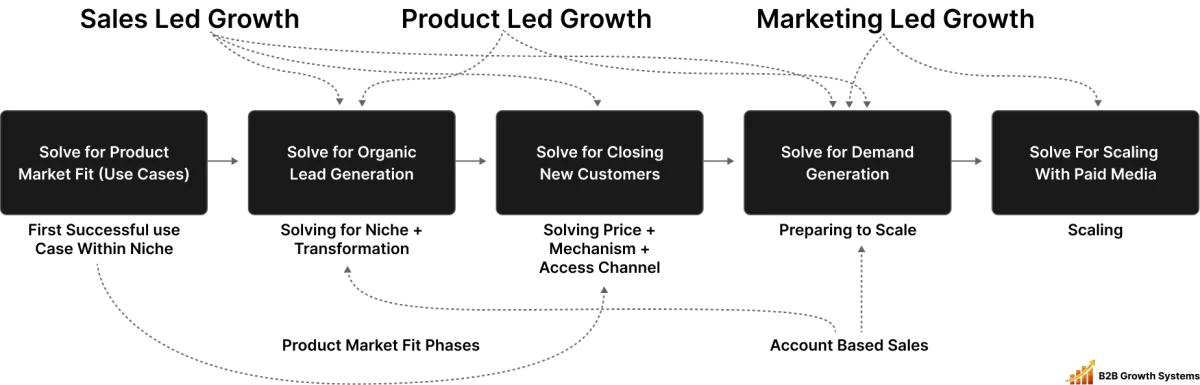
Every B2B company must navigate five sequential phases to achieve sustainable growth.
The sequence is not arbitrary. Each phase creates the preconditions for the next.
Attempting to execute a later phase before completing an earlier one is the primary cause of wasted resources, failed campaigns, and stalled growth.
Phase I
Product-Market Fit
Validating that your offer solves a genuine problem for a defined market willing to pay. Without this foundation, all subsequent investment is speculation.
Phase II
Lead Generation
Building systematic outbound mechanisms that convert cold prospects into qualified leads. This phase establishes repeatable processes for initiating commercial conversations.
Phase III
Closing New Customers
Developing the sales processes, scripts, and conversion mechanisms required to transform leads into paying customers. This phase proves the economic viability of the model.
Phase IV
Demand Generation
Creating content, positioning, and market presence that attracts buyers throughout their journey. This phase builds gravity—the ability to draw prospects toward you without direct outreach.
Phase V
Scaling with Paid Media
Amplifying validated systems through paid advertising channels. Only after proving organic effectiveness should capital be deployed to accelerate growth.
Four Interconnected Bodies of Methodology
B2B Growth Systems comprises four interconnected bodies of methodology.
Each doctrine is complete in itself yet designed to integrate with the others.
Together, they form a comprehensive operating system for B2B revenue generation.
DOCTRINE I
Product-Market Fit
Product-market fit is not a milestone to be achieved and forgotten. It is a dynamic state requiring continuous validation.
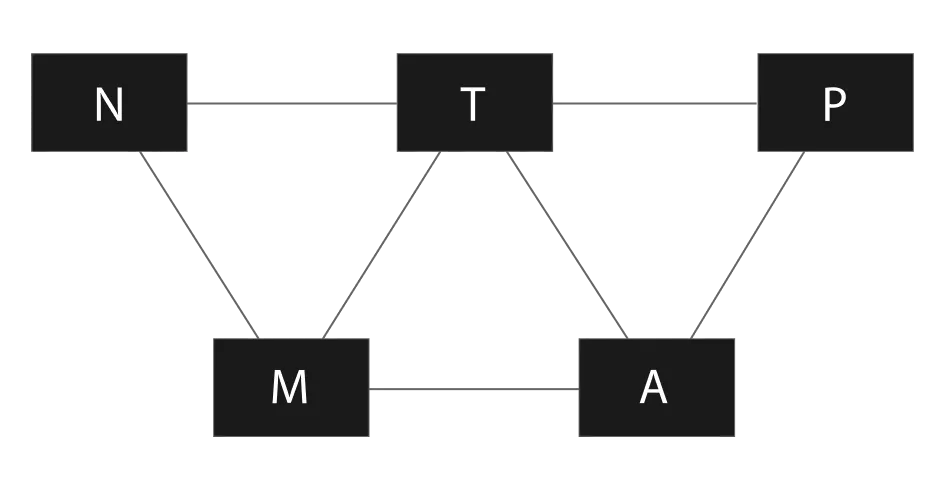
This doctrine introduces the N-T-P-M-A Framework—a structured approach to validating and refining the five interdependent variables that determine market viability:
Niche (N): The specific group experiencing the problem you solve
Transformation (T): The measurable change your solution delivers
Price (P): The economic exchange the market will bear
Mechanism (M): The vehicle through which transformation is delivered
Access Channel (A): The pathways through which your message reaches the market
The doctrine details the Customer Development Model, contrasting it with the traditional Product Development Model that has led countless companies to build solutions for problems that do not exist, or that exist but generate no willingness to pay.
DOCTRINE II
Lead Generation
Lead generation is the discipline of converting strangers into prospects and prospects into leads. It is prospecting in the original sense-searching through a defined population to identify those who demonstrate genuine interest in your solution.
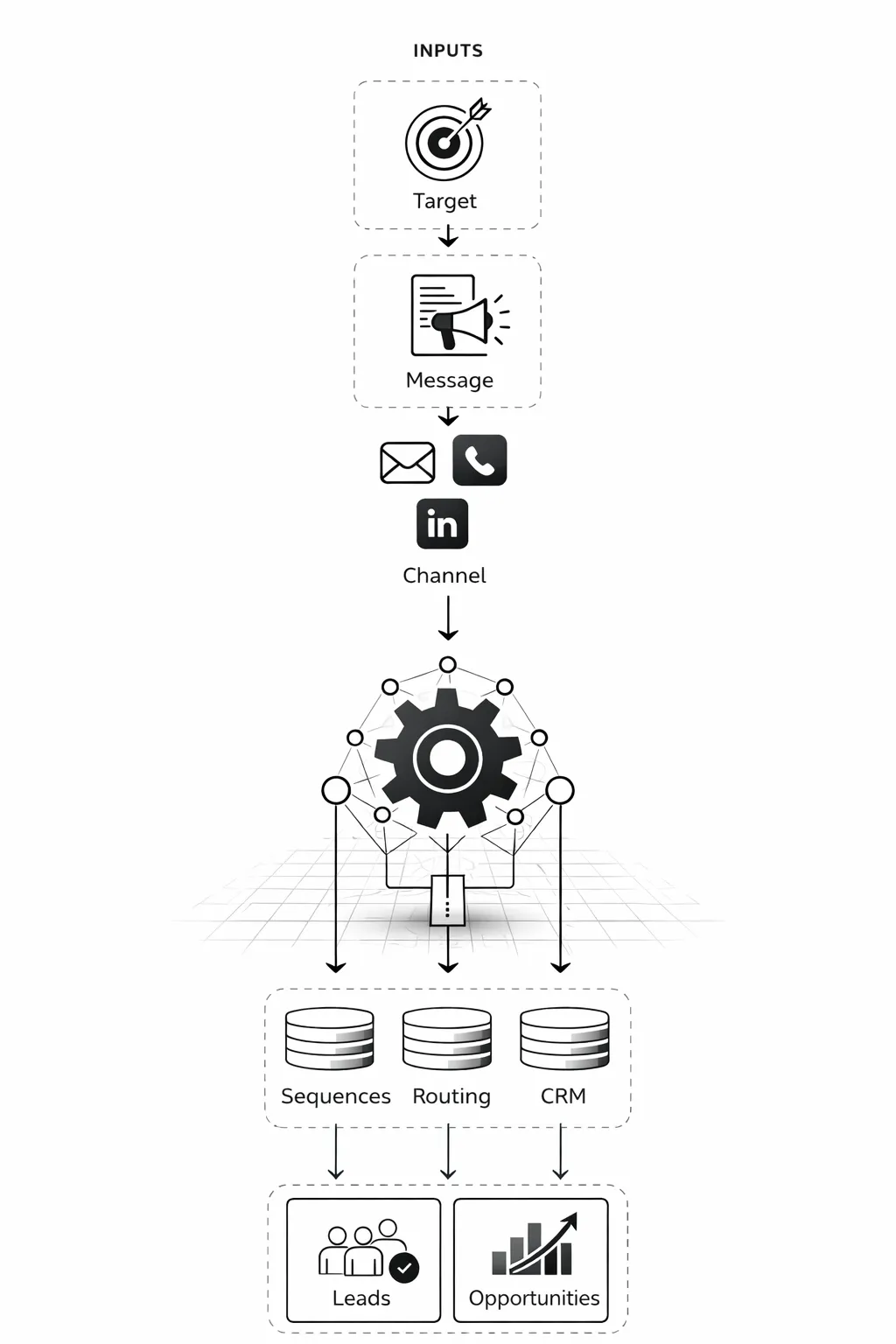
This doctrine establishes precise definitions for terminology the industry has confused for decades. It introduces the Exposure Lead Rate as the primary metric for measuring message-market resonance. It details the construction of outbound systems across email, LinkedIn, and telephone channels.
Central to this doctrine is the understanding that not all leads are equal. Leads must be categorised by their position in the buyer's journey—Top of Funnel, Middle of Funnel, or Bottom of Funnel—and engaged accordingly. A system that treats all leads identically will convert poorly regardless of volume.
The doctrine presents the 4P Approach: Pinpoint, Present, Process, Parse—a methodology for systematically testing market response and scaling what works.
DOCTRINE III
Demand Generation
Demand generation is the discipline of creating market gravity. Where lead generation pushes outward to find buyers, demand generation pulls buyers inward through valuable content, strategic positioning, and systematic nurturing.
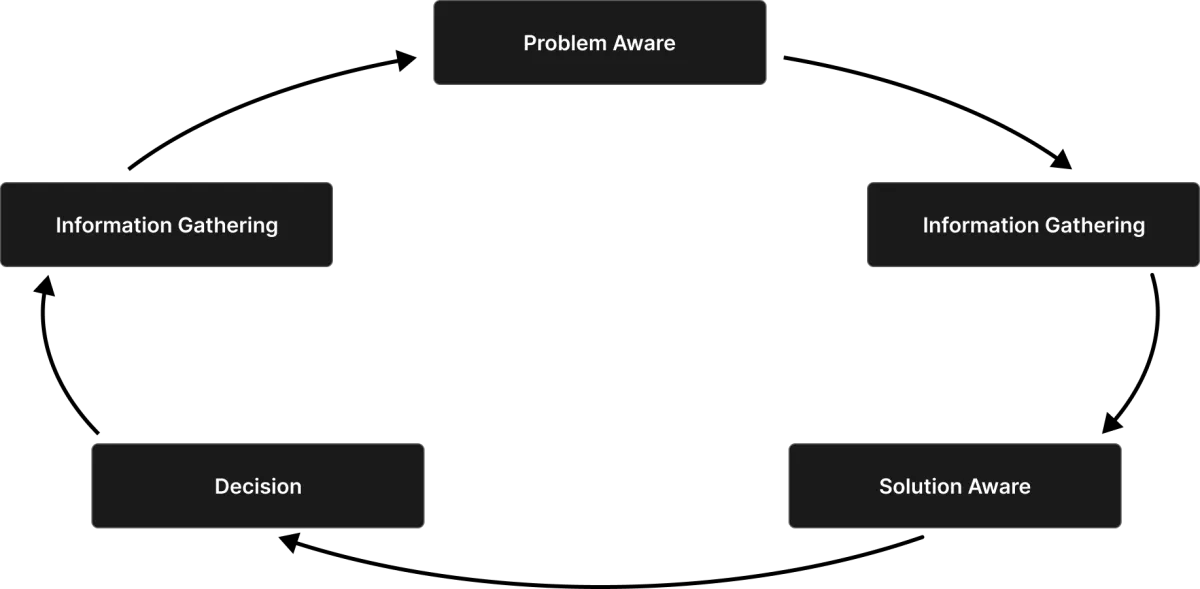
This doctrine addresses the buyer's journey in its true form—not as a linear progression from awareness to decision, but as a cyclical, recursive process in which buyers advance, retreat, reconsider, and return.
The doctrine introduces four content archetypes—Poet, Professor, Preacher, and Promoter, and maps their deployment across the sales funnel. It details the construction of feedback loops between sales and marketing, the development of Black Hole Content that attracts and retains attention, and the 80/20 distribution rule that governs content deployment.
Understanding demand generation transforms a company from one that must constantly hunt for customers into one that customers seek out.


DOCTRINE IV
Scaling with Paid Media
Paid media is an accelerant. Applied to validated systems, it multiplies results. Applied to unvalidated systems, it multiplies losses.
This doctrine establishes the preconditions for paid media deployment: a proven Top of Funnel asset, a validated Middle of Funnel conversion mechanism, and demonstrated closing capability through organic channels.
Only when these elements are in place should capital be allocated to paid acquisition. The doctrine details the construction of paid funnels across platforms, the metrics that govern scaling decisions, and the integration of paid traffic with existing organic systems.
The goal is not advertising. The goal is building a machine that converts investment into revenue at a predictable, scalable ratio.
The Cyclical Nature of the Buyer's Journey
Traditional frameworks present the buyer's journey as linear: a prospect becomes aware, considers options, and makes a decision. This model is useful for initial understanding but fails to capture how buyers actually behave.
In practice, buyers move forward and backward, sometimes within a single conversation. A prospect who appeared ready to purchase may encounter internal resistance and return to the research phase.
The integration of outbound and inbound systems, push and pull, active and passive—creates a revenue infrastructure capable of meeting buyers wherever they are, whenever they arrive, and however they move.
The Customer Acquisition Machine
When all components are operational and integrated, they form what we term the Customer Acquisition Machine, a comprehensive system that seamlessly attracts, engages, qualifies, converts, and retains customers.
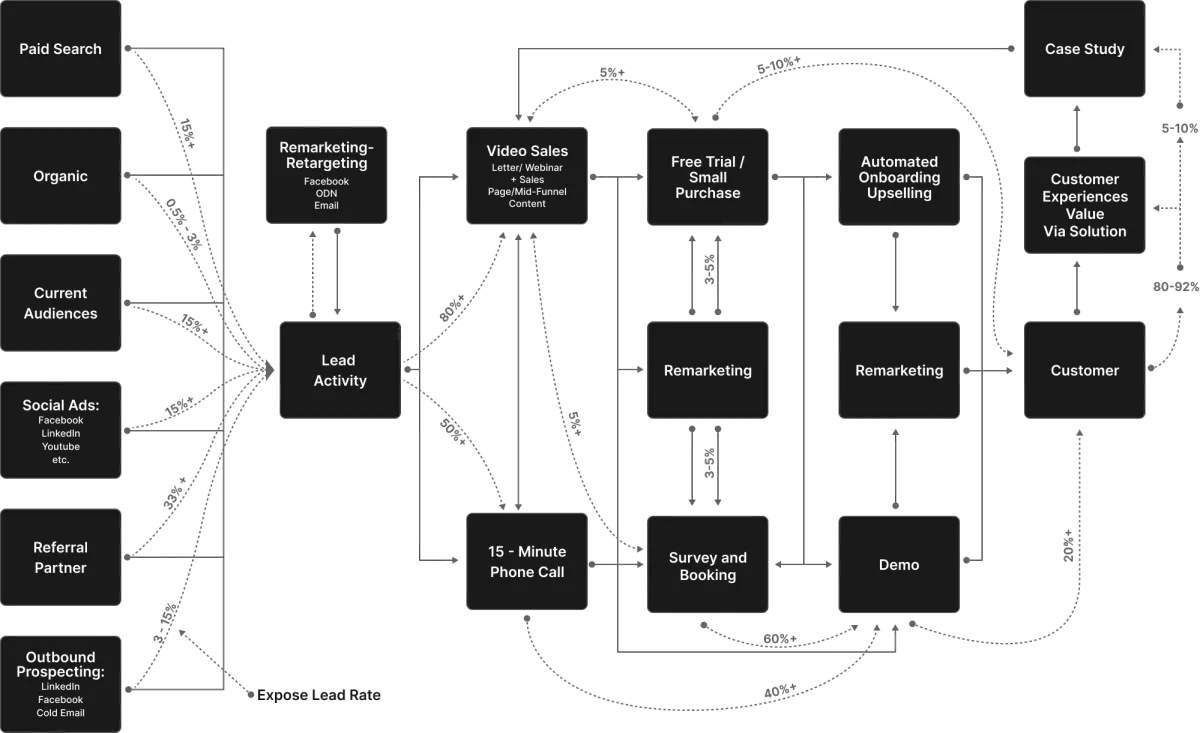
The machine comprises:
Traffic Sources
Outbound prospecting, referrals, social advertising, search engine optimisation, pay-per-click campaigns, content marketing, and offline events.
Lead Capture
Top of Funnel through Bottom of Funnel content assets designed to capture prospect interest and initiate engagement.
Lead Qualification
Mechanisms ensuring leads meet defined criteria before advancing to sales conversations.
Engagement and Nurturing
Educational content sequences that build trust, address objections, and maintain presence throughout the buyer's journey.
Sales Process
Discovery calls, demonstrations, proposals, and closing mechanisms appropriate to the offer and market.
Remarketing
Systems targeting leads who did not convert on initial exposure, maintaining presence until they return.
Case Study Collection
Post-sale processes capturing success stories, testimonials, and proof that fuel future marketing efforts.
Feedback Loop
Continuous refinement based on market response, sales team input, and customer outcomes.
Technology Integration
CRM systems, analytics platforms, and automation tools providing visibility and control across the entire machine.

James Carby-Robinson
Founder & Architect
Origin and Authority
James Carby-Robinson
Founder & Architect
B2B Growth Systems was developed by James Carby-Robinson over eighteen years of frontline sales and marketing experience.
Beginning in direct sales at age sixteen, James built a healthcare recruitment agency by age eighteen, closed multimillion-dollar technology contracts across Europe by age twenty-three, and served as Vice President of Sales and Marketing for a Chicago-based revenue generation firm consulting to companies across four continents.
This methodology was not developed in a classroom. It was forged through thousands of sales conversations, hundreds of campaigns, and direct accountability for revenue outcomes. Every principle contained in these doctrines has been tested against the only measure that matters: whether it generates customers.
James has worked with software companies, consulting firms, technology providers, offshore development agencies, SaaS platforms, and professional services firms. The patterns that emerged across these engagements, what works, what fails, and why, form the foundation of this doctrine.
Companies from 18 years of B2B sales and marketing practice













Methodology Requires Evidence.
The following engagements demonstrate what B2B Growth Systems produces across different industries, price points, and market conditions—including cases where the system correctly diagnosed that conditions for growth did not exist.
Success Cases
Ecoloxtech
Industrial Sanitization Technology • 22 Months • Ongoing
Hypochlorous acid generator manufacturer. Built complete multi-vertical growth infrastructure from validated product.
#1 Google ranking for primary keyword
10-30 automated B2B leads monthly
5x ROAS sustained across paid channels
15+ active industry verticals
Enterprise relationship initiated with major CPG brand
HK Defense Solutions
Executive Protection • 90 Days • Renewed
High-ticket security services for family offices and corporations. Annual contracts starting at $750K+.
8 niche-specific funnels built
100+ nurture emails across 8 sequences
LinkedIn content system generating significant engagement
Client positioning score: 9/10
Partnership renewed and expanded
SoftwareX
B2B SaaS • 14 Months
Smartsheet consultancy launching new product. Zero customers at engagement start.
First paying customer acquired
$59,500 qualified pipeline across 16 opportunities
120+ organic leads in first month
30% response rate (industry average: 1-5%)
Partnership renewed and expanded
Plexian
Technology Distribution • 5+ Years • Ongoing
Independent European distributor for A-rated brands including Adidas, Nike, Logitech, BaByliss.
Pan-European market coverage
Precision email marketing at scale
Major retailer accounts secured (Notino, Alza)
Premium brand agreements negotiated
Millions in annual revenue contribution
INSTRUCTIVE CASES
Keyura
Two Products • 55 Demos Generated • Both Discontinued
Same founder, two products (Logistics SaaS, HR Technology). System generated 55 demos across both engagements. Founder attended fewer than 20% of scheduled demos. One customer acquired for $5,000. Both products discontinued within five years.
Diagnosis: Lead generation performed. Product-market fit did not exist. Founder engagement was insufficient. The system correctly identified unwinnable conditions—a diagnosis rejected at the time but validated by subsequent discontinuation.
WonderBiz
Offshore Software Development • 18 Months
• Engagement Complete
Stage 5 saturated market. Client sought to differentiate through outbound in a commoditized industry where buyers default to existing relationships and referrals.
13,604 prospects processed across 18 months
89 qualified leads generated
40+ sales meetings booked
Close rate: 0%
Revenue generated: $0
Diagnosis: Lead generation system performed as designed. The failure occurred at conversion—cultural barriers, intellectual property concerns, and pricing resistance in a market where trust is built through referral, not outreach. The system correctly identified that outbound alone cannot overcome structural market barriers. Some markets require different entry strategies.
The Pattern:
When product-market fit exists and founder engagement is present, the system generates leads, pipeline, and revenue.
When product-market fit is absent, the system identifies that absence; often before the client is willing to accept the diagnosis.
When leads are generated but deals don't close, the system isolates whether the failure is lead quality, sales execution, pricing, or market timing.
When market structure itself prevents outbound success, the system surfaces that reality; saving years of wasted effort on the wrong channel.
This is what methodology produces: not magic, but clarity.
From Doctrine to Execution
For companies seeking to implement B2B Growth Systems methodology, FlameFunnels serves as the execution partner.
FlameFunnels provides done-for-you and done-with-you implementation of the systems described in this doctrine: lead generation infrastructure, demand generation content systems, sales process development, CRM configuration, and paid media deployment.
The doctrine provides the blueprint. FlameFunnels builds the machine.
Access the Full Doctrine
DOCTRINE I
Product-Market Fit
The foundation. Validating your offer before investing in growth.
DOCTRINE II
Lead Generation
The engine. Systematic prospecting that fills your pipeline.
DOCTRINE III
Demand Generation
The gravity. Content and positioning that attracts buyers.
DOCTRINE IV
Scaling with Paid Media
The accelerant. Amplifying what works through paid channels.

Case Studies
Contact
85 Great Portland Street, London, W1W 7LT
The methodology for predictable B2B revenue.
© 2026 B2B Growth Systems. All rights reserved.